

Prerequisites (once per merchant/environment)
You need the following credentials and configuration elements before calling the SIBS SPG APIs:
- AuthToken : (used as
Authorization: Bearer <AuthToken>for REST calls), - TerminalId : the terminal ID assigned to the merchant, by the SIBS OnBoarding team
- X-IBM-Client-Id : merchant application identifier assigned by the SIBS OnBoarding team
Choose the appropriate environment URLs. The API base URL (<ROOT_URL>) and hosted widget URL (<WIDGET_URL>) must correspond to the same environment.
For environment-specific URL values, refer to A.3 – API Requests.
API Request Flow
The following diagram summarizes the complete Credit Card Form Integration flow before the detailed implementation steps.
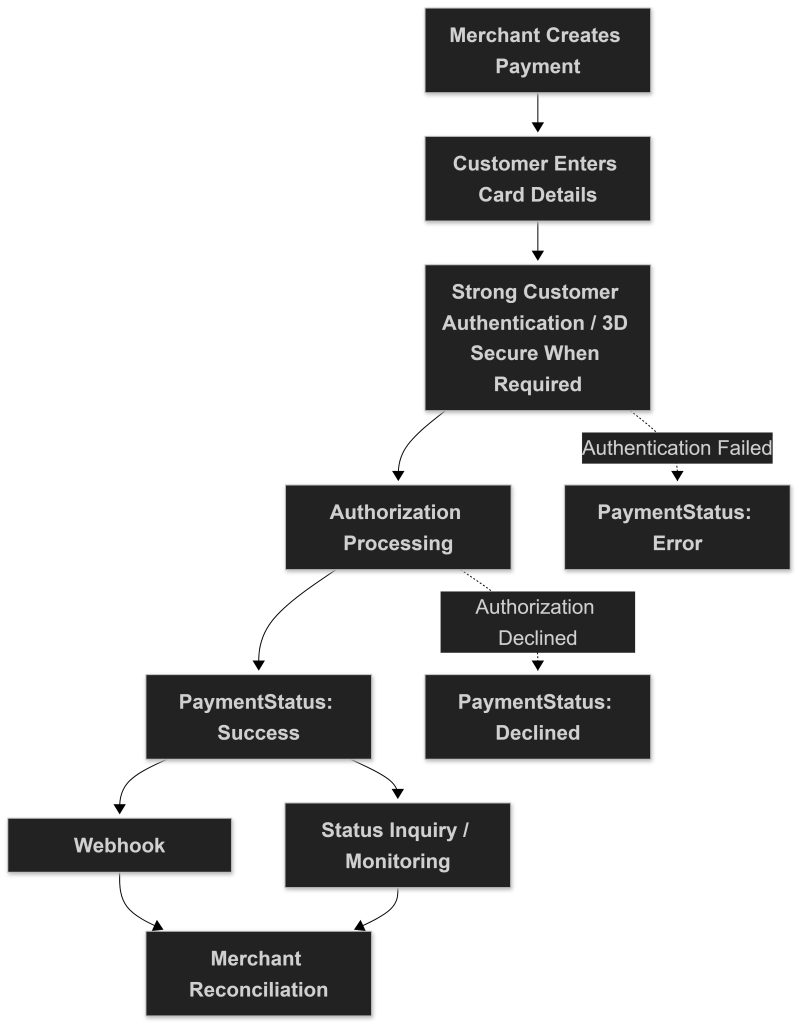
1) Create the Checkout Session (server-to-server)
Goal: Create the checkout session in SIBS SPG and obtain the identifiers required to render the hosted Credit Card payment form.
Implementation steps
1.1 POST Checkout Payment to:
curl -v -X POST '<ROOT_URL>/payments' \
--header "X-IBM-Client-Id: dd43****" \
--header "Authorization: Bearer 0276****" \
--header "Accept: application/json" \
--header "Content-Type: application/json" \
--data '
{
    "merchant": {
      "terminalId": "<TerminalId>",
      "channel": "web",
      "merchantTransactionId": "teste 123"
    },
    "transaction": {
      "transactionTimestamp": "2028-12-31T00:00:00.000Z",
      "description": "Teste",
      "moto": false,
      "paymentType": "PURS",
      "amount": {
        "value": "<amount>",
        "currency": "EUR"
      },
      "paymentMethod": [
        "CARD"
      ]
    },
    "customer": {
      "customerInfo": {
        "customerName": "Onboarding",
        "customerEmail": "Onboarding@teste.com",
        "shippingAddress": {
          "street1": "Rua 123",
          "street2": "Porta 456",
          "city": "Lisboa",
          "postcode": "1200-999",
          "country": "PT"
        },
        "billingAddress": {
          "street1": "First street",
          "street2": "Menef Square",
          "city": "Lisbon",
          "postcode": "1700-123",
          "country": "PT"
        }
      }
    }
  }'
Headers
Authorization: Bearer <AuthToken>X-IBM-Client-Id: <ClientId>Content-Type: application/jsonAccept: application/json
Implementation steps
- Create a new payment session.
- Define the payment type (
PURSfor one-off purchase). - Restrict the payment method to
"CARD". - Provide customer information as required by the merchant configuration defined during onboarding.
- Send the total amount and currency.
This call registers the payment and prepares the transaction for the hosted form.
1.2. Store from the successful response:
The SPG transactionID should be treated as the authoritative identifier for transaction monitoring, webhook correlation, reconciliation, refund operations, and Status Inquiry requests throughout the transaction lifecycle.
From the Checkout response, you must store:
transactionID: (you’ll inject it in the widget script URL)transactionSignature: (you’ll inject it into the HTML form attribute)formContext: (you’ll inject it into the HTML form attribute)paymentMethodList: (SIBS SPG may also return available methods)
These values are required to:
- Load the SIBS SPG widget
- Render the payment form
- Perform server-side status validation
Notes
merchantTransactionIdis your internal order identifier (max 35 characters).paymentTypemust be"PURS"for one-off purchase- The
customer.customerInfoblock is required for Credit Card transactions according to the merchant configuration defined during onboarding. - The checkout session expires after 10 minutes. If the session expires, a new checkout must be created.
2) Create the payment form link (Widget) + customization (front-end)
Goal: Render the SIBS SPG payment form, collect cardholder payment details, and allow the customer to complete the payment authorization flow.
2.1 Include the SIBS SPG widget script (using transactionID)
Add the script tag to your checkout page:
<script src="<WIDGET_URL>/assets/js/widget.js?id={transactionID}"></script>This is the standard Form Integration approach and the script URL includes the transactionID.
2.2 Add the <form> element and inject formContext + transactionSignature +config/style
You must have a form with class paymentSPG and the SIBS SPG attributes:
<form class="paymentSPG"
      spg-context="{formContext}"
      spg-signature="{transactionSignature}"
      spg-config="{formConfig}"
      spg-style="{formStyle}">
</form>
SIBS SPG explicitly defines:
spg-context: theformContextyou received from Checkoutspg-signature: thetransactionSignatureyou received from Checkoutspg-config: merchant configuration (JSON string),spg-style: optional styling configuration (JSON string).
2.3 formConfig – minimal config for Credit Card one-time
At minimum, your config should:
- Restrict the form to Credit Card using
paymentMethodList - Set
redirectUrl(where the customer returns after the form finishes) - The amount is defined in the Checkout request and does not need to be redefined in
formConfig. - Set
languageto match your checkout language.
Example (conceptual):
const formConfig = JSON.stringify({
  paymentMethodList: ["CARD"],
  redirectUrl: "https://merchant.example.com/payment-return",
  language: "en"
});
Supported values for paymentMethodList include MBWAY, REFERENCE, CARD (display depends on merchant permissions).
2.4 formStyle – optional UI customization
If you want to align the SIBS SPG form with your brand, SIBS SPG supports a style object with parameters like layout/theme/colors/font.
Example (conceptual):
const formStyle = JSON.stringify({
  layout: "default",
  theme: "light",
  color: {
      primary: "#0033A1"
  }
});
Optional: react to “Pay” click events in real time
SIBS SPG supports event monitoring via window.postMessage from the iframe so you can show a spinner / tracking / UX actions when the user clicks “Pay”.
What Happens After Form Submission?
- The customer enters card details in the hosted form.
- The transaction is sent to the acquiring network.
- Strong Customer Authentication (3D Secure) may be automatically triggered by the issuer.
- The issuing bank approves or declines the transaction.
- The customer is redirected to the configured
redirectUrl. - The final payment status must be confirmed server-to-server (Step 3).
Credit Card Behaviour
- Credit Card is a real-time payment method.
- Authorization response is typically immediate in non-3DS scenarios.
- 3D Secure authentication may introduce a short processing period.
- The transaction may temporarily remain in
Pendingwhile authentication or transaction processing is being completed. - The payment must only be considered completed when
paymentStatus = Success.
Notes
- The hosted form is PCI DSS compliant and securely handled by SIBS SPG.
- All cardholder data (
PAN,secureCode,validationDate,cardholderName) is collected exclusively inside the SIBS SPG environment. - Card data never touches the merchant server, significantly reducing PCI DSS scope.
- If the checkout session expires (10 minutes), the hosted form will no longer load correctly, and a new checkout session must be created.
- Even after redirection, the final transaction result must always be validated via the status endpoint.
3) Validate the Final Transaction Status (Back-End)
Goal: Confirm the final payment outcome after the customer completes the Credit Card payment flow.
Even though Credit Card is a real-time payment method, the final result must always be validated server-to-server.
3.1 When to check status
You should verify the transaction status:
- After the customer is redirected to the
redirectUrl - After receiving a webhook notification, if configured
Unlike Multibanco Reference, Credit Card payments do not remain pending for extended periods.
However:
- During 3D Secure authentication, the transaction may temporarily remain in
Pendingwhile the authentication result is being processed by SPG.
The transaction must only be considered finalized after confirming the status via API.
Important: The redirectUrl does NOT guarantee that the payment was successful. Always confirm the final payment outcome server-side.
3.2 Status endpoints you can use
The following Status Inquiry options are commonly used:
GET <ROOT_URL>/payments/{transactionID}/statusGET<ROOT_URL>/payments/status?merchantTransactionId=...
curl -v -X GET "<ROOT_URL>/payments/{transactionID}/status" \
--header "X-IBM-Client-Id: dd43****" \
--header "Authorization: Bearer 0276****" \
--header "Accept: application/json" \
--header "Content-Type: application/json"
For example, s2iCzUbsAAs5CSjzSFVE represents a transactionID returned by the Checkout request.
3.3 Required headers (status call)
Authorization: Bearer <AuthToken>X-IBM-Client-Id: <ClientId>Content-Type: application/jsonAccept: application/json
3.4 What statuses to expect (high level)
The response includes paymentStatus, typically with values such as:
SuccessDeclinedErrorPendingTimeout
Credit Card behaviour
Success: Authorization approved and funds captured (forpaymentType = PURS)Declined: Transaction refused by issuerError: Technical or processing errorPending: Temporary state during authentication or processing (e.g., 3D Secure challenge flow)
The transaction must only be considered completed when paymentStatus = Success.
3.5 Recommended validation strategy
For Credit Card Form Integration:
- After redirection, immediately call the
/statusendpoint. - Do not rely solely on front-end redirection parameters.
- If
Pending, retry status after a short delay (few seconds). - Stop when a final state is reached (
Success,Declined,Error,Timeout).
Polling for Credit Card should be short-lived and limited to the authentication window.
Webhook notifications should be treated as the preferred mechanism for transaction lifecycle monitoring and operational reconciliation.
The Sandbox Payment Simulator may also be used to validate Credit Card Form Integration flows, hosted payment form behaviour, customer authentication scenarios, transaction lifecycle progression, and operational request/response payloads in the sandbox environment.
Example sandbox simulator entry point
For webhook delivery and processing guidance, refer to E.1 – Webhooks (Notifications).
For transaction lifecycle monitoring and Status Inquiry operations, refer to E.2 – Status Inquiry / Get Status.
Important Notes
- Credit Card is a real-time payment method, except when Strong Customer Authentication (3D Secure) introduces an authentication step.
- There is no extended waiting period (unlike Multibanco Reference).
- The final payment confirmation must always be validated server-to-server.