

Overview
The SIBS Payment Gateway operates using an event-driven, eventually consistent model for transaction state management.
In this model:
- Webhooks provide asynchronous event notifications
- Status Inquiry APIs (Query) provide synchronous state retrieval
These two mechanisms serve complementary roles and must be used together to ensure correct, reliable, and consistent transaction processing.
Conceptual Model
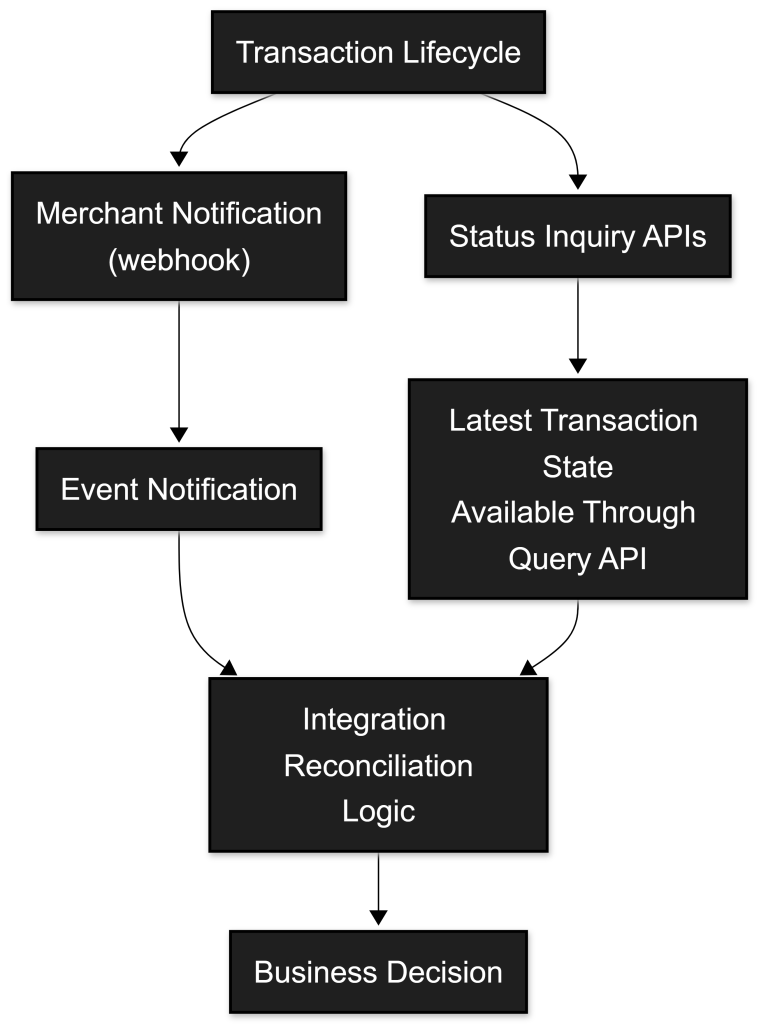
Transaction state visibility is achieved through two distinct mechanisms:
- Event Stream (Webhooks) → reflects events as they occur
- State Snapshot (Status Inquiry APIs) → reflects the current known state
These mechanisms are not guaranteed to be synchronized at all times.
Temporary inconsistencies between webhook events and queried state are expected and must be handled explicitly by the integration logic.
Transaction State Query Model
The Status Inquiry APIs provide the latest transaction state available through the query API.
Webhooks are event notifications and may contain a final paymentStatus that can be used for business processing.
Important:
- Business-critical decisions may rely on a final webhook
paymentStatusor on Status Inquiry validation when no final webhook is available or when additional confirmation is required - Final transaction outcomes should be validated using the Status Inquiry APIs when no final webhook is available or when additional confirmation is required

Consistency Characteristics
The system exhibits the following consistency properties:
- Eventual consistency between event notifications and queryable state
- Non-deterministic delivery timing of webhook events
- No guarantee of event ordering
- Possible duplication of webhook events
As a result, temporary inconsistencies between webhook data and queried state are expected.
Typical Inconsistency Scenarios
Scenario 1: Webhook arrives before final state is available
- Multibanco Reference generation notification may indicate
Pendingbefore final payment completion
Guidance:
- Continue polling
- Wait for final state
Scenario 2: Status updated before webhook delivery
- Status Inquiry APIs return
Success - Webhook has not yet been received
Guidance:
- Use the Status Inquiry APIs to retrieve the latest transaction state available through the query API
- Do not block processing waiting for webhook
Scenario 3: Webhook delivered out of order
- Older event received after a newer one
Guidance:
- Use Status Inquiry APIs to resolve ordering inconsistencies when required
- Do not assume webhook order reflects lifecycle order
Scenario 4: Duplicate webhook delivery
- Same webhook received multiple times
Guidance:
- Implement idempotent processing
- Avoid duplicate business actions
Webhook retry behavior, delivery guarantees, and idempotency handling are described in E.1.3 – Webhook Delivery, Retries and Idempotency.
Scenario 5: Missing webhook
- No webhook received due to delivery failure
Guidance:
- Use polling as fallback
- Query transaction state until final
Polling strategies, backoff models, and stop conditions are described in E.2.5 – Polling Strategy and Best Practices.
State Reconciliation Strategy
To ensure consistent and reliable transaction handling, integrators must implement a reconciliation strategy based on the following principles:
- Validate transaction state using the Status Inquiry APIs when no final webhook is available or when additional confirmation, recovery, reconciliation, or inconsistency resolution is required
- Use webhooks as event notifications; when they contain a final
paymentStatus, that status can be used for business processing - Reconcile differences between:
- Last received webhook state
- Latest queried transaction state
Recommended Integration Pattern
A robust integration should follow this pattern:
- Initiate transaction
- Start polling (short-lived) for immediate feedback
- Receive webhook notification(s)
- Query Status Inquiry APIs
- Confirm final state
- Trigger business action
Decision Model
| Condition | Action |
|---|---|
| Webhook received | Validate state via the Status Inquiry APIs |
| Polling detects a typically final state | Validate operational context and proceed with business logic when appropriate |
| Webhook and query disagree | Trust the Status Inquiry APIs |
| No webhook received | Continue polling within limits |
Handling Transient States
While the transaction is in a non-final state:
Pending
Integrators must:
- Continue polling according to defined strategy
- Wait for either:
- Final state via query
- Webhook confirmation
Handling Final States
Final states include:
SuccessDeclined
Potentially final depending on context:
ErrorTimeout
Error and Timeout states may still require operational reconciliation or asynchronous validation depending on the payment method and transaction lifecycle stage.
Guidelines:
- Only final states should trigger irreversible business actions
- Final state must be confirmed via the Status Inquiry APIs
Idempotency and Safe Processing
Due to possible duplication and reordering:
- Webhook processing must be idempotent
- Business actions must not be executed multiple times
- Transaction state evaluation must be repeatable and safe
Integration Anti-Patterns
The following practices must be avoided:
- Relying exclusively on webhook payloads that do not contain a final
paymentStatus - Ignoring the Status Inquiry APIs validation
- Assuming webhook delivery order
- Triggering business actions on transient states
- Polling indefinitely without stop conditions
Key Integration Principles
- Use the Status Inquiry APIs to retrieve the latest transaction state available through the query API when required
- Use webhooks as event notifications; when they contain a final
paymentStatus, they may be used for business processing - Design for eventual consistency and temporary inconsistencies
- Implement reconciliation logic between query and webhook
- Ensure idempotent processing of events
Summary
The SIBS Payment Gateway consistency model is based on event-driven notifications combined with transaction-state queries when required.
By correctly combining:
- Webhooks (event stream)
- Status Inquiry APIs (state validation)
Integrators can ensure:
- Accurate transaction state handling
- Resilient and fault-tolerant systems
- Correct execution of business processes
This model is essential for achieving reliable, scalable, and auditable payment integrations.
The Inquiry Details API may expose Merchant Initiated Transaction (MIT) attributes, including type and amount qualifiers, providing additional context for recurring and subsequent transactions.
This information complements, but does not replace transaction-state validation through the Status Inquiry APIs when required.