

Overview
Error handling is a critical component of any integration with the SIBS Payment Gateway.
Due to the distributed, asynchronous, and eventually consistent nature of the system, integrators must be prepared to handle:
- Technical failures
- Business-level rejections
- Transient inconsistencies
- Edge-case scenarios arising from timing, delivery, and system behavior
This chapter defines how to detect, classify, and handle errors and edge cases to ensure robust and reliable transaction processing.
Error handling strategies must be designed in alignment with the consistency model defined in E.2.6 – Consistency Model: Query vs Webhook.
Error Classification Model
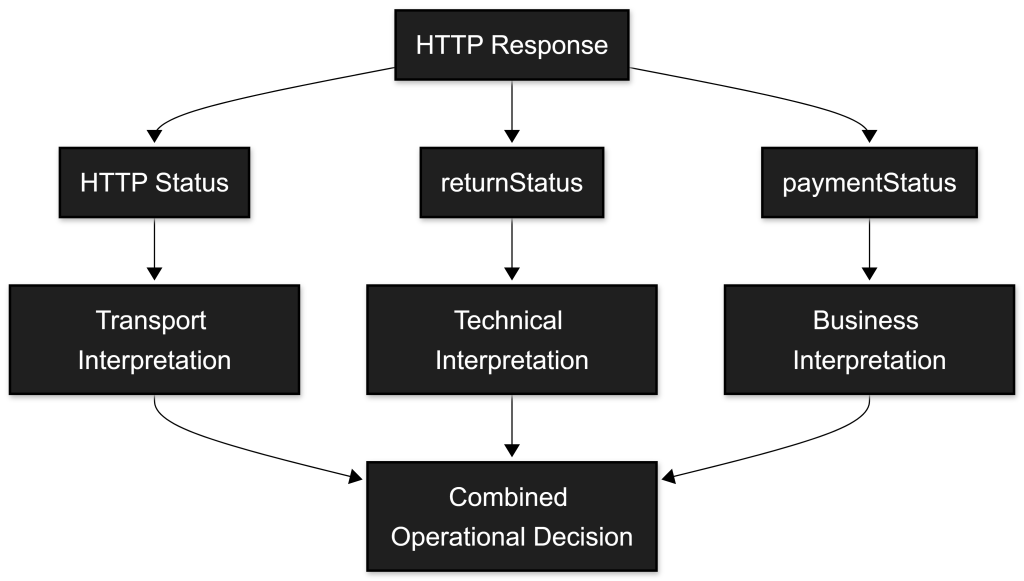
Errors must be interpreted using a multi-layer model, combining:
- HTTP response status
returnStatus.statusCodepaymentStatus
Each layer provides different information and must be evaluated together.
HTTP-Level Errors
HTTP status codes indicate the result of the API request itself, not the transaction outcome.
Common HTTP Errors
| HTTP Code | Meaning | Handling |
|---|---|---|
400 Bad Request | Invalid request | Validate payload and parameters |
401 Unauthorized | Authentication failure | Verify Bearer token and credentials |
403 Forbidden | Access denied | Check client permissions and configuration |
404 Not Found | Transaction not found | Validate transactionID |
500 Internal Server Error | Server-side failure | Retry with backoff |
Application-Level Errors (returnStatus)
The returnStatus object provides detailed error information.
Key Principles
statusCode = "000"indicates successful request processing
→ This does not necessarily imply successful payment completion or successful business outcome.- Non-zero codes indicate errors or exceptional conditions
- Codes must be interpreted according to C.5 – Status Codes and Error Codes Catalogue
Business-Level Outcomes (paymentStatus)
The paymentStatus field defines the business result of the transaction.
Important Distinction
- A request can be technically successful (
statusCode = "000") - While the transaction is not successful (
paymentStatus = Declined,Pending, etc.)
For detailed interpretation of transaction states, refer to E.2.4 – Status Semantics and Interpretation.
Combined Error Interpretation
| HTTP Status | returnStatus.statusCode | paymentStatus | Interpretation | Action |
|---|---|---|---|---|
200 | 000 | Success | Successful payment | Proceed with business processing |
200 | 000 | Pending | Awaiting completion | Continue polling using the defined strategy |
200 | 10.x.xxxx | Declined | Business rejection | Do not retry automatically |
200 | 12.x.xxxx | Error | Technical failure | Investigate and apply retry only if the condition is classified as temporary (Txxxx) |
500 | — | — | Server error | Retry with backoff |
Business actions must always be based on the combined evaluation of all layers and never on a single indicator in isolation.
Final interpretation must always consider all three layers together. No single field (HTTP, returnStatus, or paymentStatus) is sufficient on its own to determine the correct operational action.
Retry Strategy
Retry behavior must be based on error type and must be aligned with the error classification model defined in C.6 – Error Payloads and Handling Guidelines:
- Temporary conditions (
statusCode = Txxxx) may be retried using controlled retry strategies (e.g., exponential backoff) - Validation or business errors (
statusCode = Exxxx) must not be retried automatically and require correction or user-driven resolution
Retryable Errors
500 Internal Server Error- Temporary network failures
- Transient
Errorstates
Guidelines:
- Use exponential backoff
- Limit retry attempts
- Avoid synchronized retries
Non-Retryable Errors
400 Bad Request401 Unauthorized(until fixed)403 ForbiddenDeclinedpayment states
Guidelines:
- Do not retry automatically
- Correct configuration or user input
Retry mechanisms must be designed to avoid amplification of system load under failure conditions.
Handling Transient States
Transient states include:
Pending
Guidelines:
- Continue polling using the defined strategy
- Do not trigger business actions
- Combine with webhook monitoring
Polling strategies, backoff models, and stop conditions are described in E.2.5 – Polling Strategy and Best Practices.
Edge Case Scenarios
Scenario: Transaction Not Found (404)
Possible causes:
- Invalid
transactionID - Query executed before transaction is fully registered
Handling:
- Validate identifier
- Retry after short delay if recently created
Scenario: Webhook Received but Status Not Updated
- Webhook event and queried state differ temporarily
Handling:
- Treat as temporary inconsistency
- Retry Status Inquiry APIs
Reconciliation patterns and transaction-state validation strategies are described in E.2.7 – Reconciliation Patterns.
Scenario: Status Updated but Webhook Missing
- Status Inquiry APIs return final state
- No webhook received
Handling:
- Proceed with appropriately validated business logic
- Log missing webhook for monitoring
Scenario: Duplicate Webhook Events
- Same webhook delivered multiple times
Handling:
- Ensure idempotent processing
- Avoid duplicate actions
Scenario: Out-of-Order Webhook Events
- Events received in incorrect sequence
Handling:
- Ignore ordering
- Validate using Status Inquiry APIs when no final webhook is available or when additional confirmation is required
Scenario: Timeout State
- Transaction not completed in expected time
Handling:
- Treat as potentially unresolved outcome requiring reconciliation or additional validation
- Allow retry only if the underlying condition is classified as temporary (
statusCode = Txxxx) or if the payment method explicitly supports retry scenarios
Scenario: Long-Running Transactions
- Transactions remain in
Pendingfor extended periods
Handling:
- Stop active polling after defined duration
- Use batch reconciliation or webhook monitoring
Defensive Integration Practices
Integrators must implement:
- Defensive parsing of response payloads
- Handling of missing or optional fields
- Protection against unexpected values or states
Observability and Logging
Effective error handling requires visibility:
- Log all failed requests and responses
- Track error codes and frequencies
- Monitor retry patterns
- Detect abnormal error rates
Alerting and Escalation
Systems should trigger alerts when:
- Error rates exceed thresholds
- Transactions remain unresolved beyond expected time
- Reconciliation failures occur
Integration Anti-Patterns
The following must be avoided:
- Ignoring HTTP status codes
- Treating
statusCode = "000"as payment success - Retrying non-retryable errors
- Acting on transient states
- Failing to log or monitor errors
Key Integration Principles
- Always evaluate all three layers: HTTP,
returnStatus, andpaymentStatus - Distinguish between technical and business errors
- Implement controlled retry strategies
- Design for transient failures and inconsistencies
- Ensure idempotent and safe error handling
Summary
Error handling in the SIBS Payment Gateway requires a multi-layered and defensive approach.
By correctly interpreting:
- HTTP response status
- Application-level result codes (
returnStatus) - Business transaction state (
paymentStatus)
Integrators can:
- Handle failures reliably
- Avoid incorrect business actions
- Build resilient and fault-tolerant systems
Proper error handling is essential for ensuring robust, scalable, and production-ready payment integrations.