

The following checklist summarizes the minimum security controls that must be verified before moving an integration to production.
Communication Security
- ⚠️ All API communication uses HTTPS (TLS 1.2 or higher)
- ⚠️ Certificate validation is enforced and not bypassed
- ⚠️ All requests are properly authenticated (Bearer / signature-based)
- ⚠️ Message integrity validation (HMAC/signature) is implemented and enforced
- ⚠️ All responses are validated before processing
- ⚠️ Webhook payloads are decrypted before use
- ⚠️ Webhook messages are validated for authenticity and integrity
Data Protection and Exposure
- ⚠️ Sensitive authentication data (e.g., CVV) is never stored, logged, or persisted
- Payment-related data is only handled and retained when operationally required and appropriately protected
- ⚠️ Sensitive data is not logged or exposed in monitoring systems
- Hosted payment flows are used where applicable to minimize data exposure
- Tokenization is used for recurring and subsequent transactions
- ⚠️ Tokens are stored securely and treated as sensitive identifiers
- Logs and debugging tools do not expose confidential information
Trust Boundaries and Input Validation
- ⚠️ All external inputs are treated as untrusted until validated
- ⚠️ API responses are validated before being processed
- ⚠️ Webhook notifications are decrypted, validated, and correlated
- ⚠️ Client-side inputs (e.g., return URLs) are not used to determine transaction outcomes without backend validation
- ⚠️ Transaction state is never updated based solely on external input
- ⚠️ All inputs are validated for structure, consistency, and authenticity
- ⚠️ Replay attempts and duplicated notifications are detected and safely rejected
Transaction Integrity Controls
- ⚠️ All operations are idempotent and protected against duplication
- ⚠️ Duplicate requests and events are detected and safely handled
- ⚠️ Retry logic is implemented and state-aware
- ⚠️ Transaction status is verified before retrying operations
- Operations are applied in a consistent and valid order
- Out-of-order and delayed events are handled correctly
- ⚠️ Transaction state transitions are validated against the expected lifecycle
- All operations are correlated and traceable
- ⚠️ Confirmed terminal transaction states are protected against regression
Operational Security Controls
- ⚠️ Access to systems is restricted based on least privilege
- ⚠️ Administrative access is limited, monitored, and auditable
- ⚠️ Credentials and secrets are stored securely (e.g., vaults)
- ⚠️ Secrets are not exposed in code, configuration, or logs
- Credential rotation policies are applied where operationally supported, and secrets are rotated immediately upon suspicion of compromise
- ⚠️ Environments (Development / Testing / Production) are strictly segregated
- ⚠️ Production data is not used in non-production environments
- Configuration changes are controlled, reviewed, and tested
- Operational activity is monitored, logged, and traceable
- Security events are detected and handled in a timely manner
- ⚠️ Access to production environments is restricted, audited, and operationally controlled
Final Verification
- ⚠️ All security controls are consistently enforced across all environments
- ⚠️ No business logic is executed on unvalidated or untrusted data
- All transaction flows have been tested under failure and retry scenarios
- Monitoring and alerting are active, operational, and verified
- ⚠️ All credentials and configuration are production-ready and secured
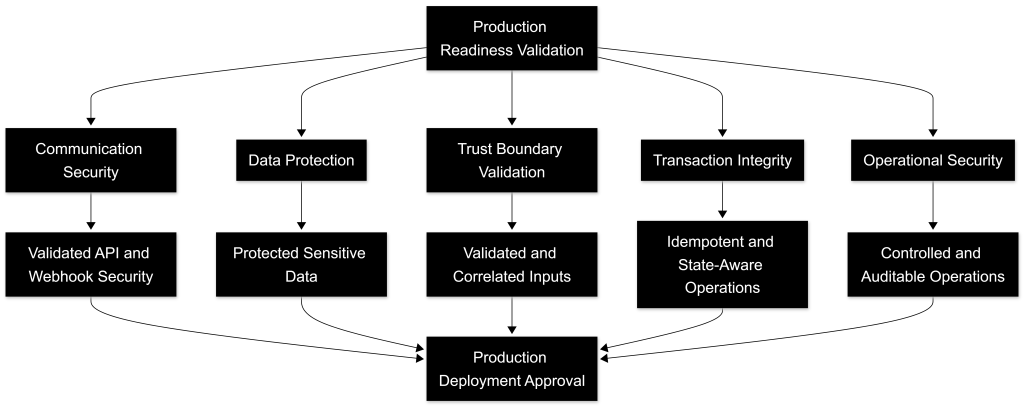
For broader production deployment, resilience, and operational readiness guidance, refer to F.6 – Production Readiness Guidelines.