

Overview
The Sandbox environment plays a critical role in the integration lifecycle by providing a controlled and deterministic context for developing, validating, and refining payment integrations.
It enables integrators to:
- Implement and test transaction flows
- Validate system behavior under predefined scenarios
- Verify handling of success, error, and edge conditions
The Sandbox must be understood as a validation and development tool, not as a representation of Production behavior, as detailed in F.8.4 – Sandbox vs Production Behavioral Gap.
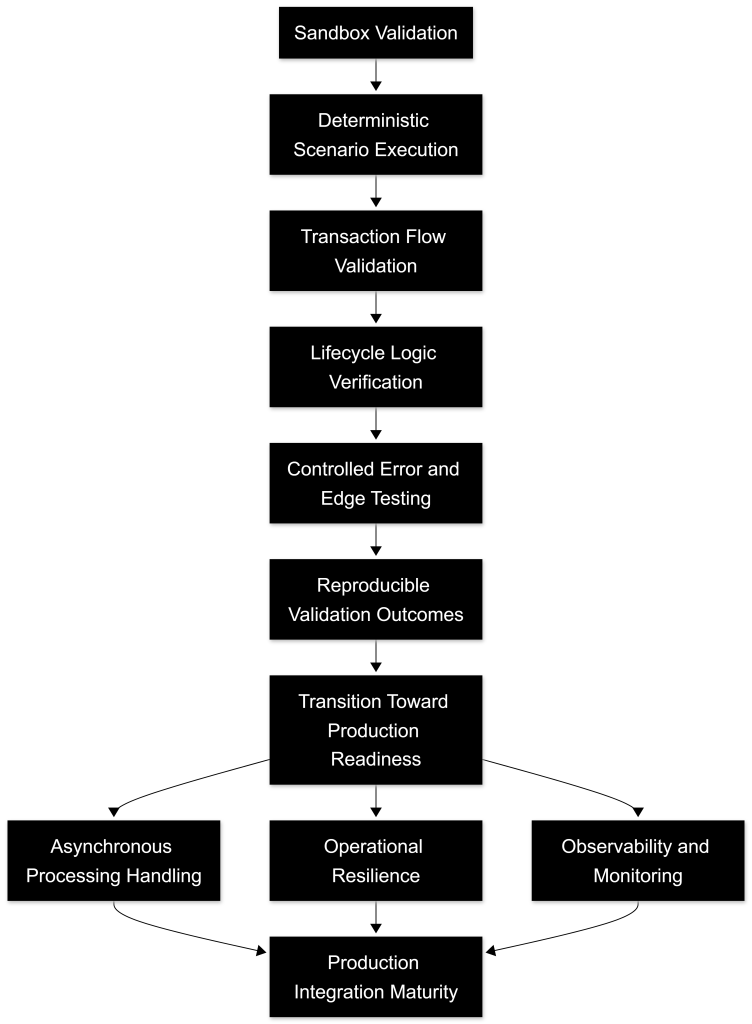
Position in the Integration Lifecycle
The Sandbox environment is used during the early and intermediate phases of the integration lifecycle.
Its primary role is to support:
- Initial implementation of API interactions
- Validation of transaction flows and state transitions
- Verification of integration logic and error handling
In this context, Sandbox execution relies on:
- The deterministic scenarios defined in F.8.1 – Deterministic Scenario Modeling in Sandbox
- The structured execution model defined in F.8.2 – Structure of a Reproducible Sandbox Flow
- The validation conditions defined in F.8.3 – Reproducibility Requirements
These elements together define the foundation for deterministic integration correctness and reproducible validation.
Scope of Validation in Sandbox
Sandbox validation is focused on verifying:
- Correct construction of requests
- Proper handling of responses
- Accurate implementation of transaction lifecycle logic
- Handling of predefined success, error, and edge scenarios
This includes:
- Execution of complete transaction flows
- Validation of
paymentStatus,returnStatus, and confirmed transaction-state outcomes - Verification of state transitions and final outcomes
Sandbox validation confirms that the integration behaves correctly under controlled and reproducible conditions.
Status Inquiry / Get Status provides transaction-state confirmation and reconciliation support throughout the integration lifecycle when required.
Validation should also include correct handling of asynchronous webhook notification propagation and consistency with Status Inquiry / Get Status results.
Limitations of Sandbox Validation
While Sandbox is essential for integration development, its scope is inherently limited.
Sandbox does not validate:
- Real-world issuer behavior
- Customer-driven interactions under production conditions
- External system variability
- Real timing and latency characteristics
These limitations are described in detail in F.8.4 – Sandbox vs Production Behavioral Gap.
As a result:
- Successful Sandbox execution does not guarantee Production behavior
- Additional validation and resilience must be implemented beyond Sandbox
Transition from Sandbox to Production
Moving from Sandbox to Production requires a shift from:
- Deterministic validation
to - Handling of real-world variability
This transition implies:
- Designing for asynchronous processing
- Handling non-deterministic outcomes
- Implementing robust error and retry strategies
- Ensuring full lifecycle observability
The structured approach defined in F.8.2 – Structure of a Reproducible Sandbox Flow remains valid but must be extended to accommodate Production behavior.
Role in Iterative Development
Sandbox supports an iterative development and validation cycle.
Typical usage includes:
- Implementing a flow
- Executing deterministic scenarios
- Validating outcomes
- Refining logic based on observed behavior
This iterative process enables:
- Progressive validation of integration components
- Early detection of implementation issues
- Controlled testing of different transaction scenarios
Reproducibility, as defined in F.8.3 – Reproducibility Requirements, is essential to ensure that each iteration produces consistent and verifiable results.
Reproducibility guarantees that integration behavior can be validated consistently across multiple execution cycles and supports reliable debugging, refinement, and lifecycle verification.
Relationship with Observability and Debugging
Sandbox provides a simplified environment for:
- Capturing request and response data
- Tracing transaction execution
- Debugging integration issues
This supports:
- Identification of incorrect request construction
- Detection of logic errors
- Validation of state transitions
However, full observability requirements must be designed with Production in mind, as described in F.8.4 – Sandbox vs Production Behavioral Gap.
See E.1 – Webhooks (Notifications) and E.2 – Status Inquiry / Get Status for detailed guidance regarding asynchronous notification handling, transaction-state reconciliation, and transaction-state confirmation and reconciliation semantics.
When extended operational diagnostics are required during lifecycle analysis or troubleshooting, additional visibility may leverage Inquiry Details as described in E.2.10 – Inquiry Details API.
Validation vs Production Readiness
Sandbox validation ensures:
- Correct implementation of integration logic
- Proper handling of predefined scenarios
- Compliance with API contract and flow structure
Production readiness, however, requires:
- Handling of real-world variability
- Resilience to external system behavior
- Robust monitoring and operational capabilities
This distinction is critical:
- Sandbox validates correctness
- Production requires resilience and adaptability
Final Consideration
The Sandbox environment is an essential component of the integration lifecycle, providing the foundation for building and validating payment integrations.
Its role is to ensure that:
- Transaction flows are correctly implemented
- Integration logic behaves as expected under controlled scenarios
- Reproducible validation is achieved
This foundation, defined through F.8.1 – Deterministic Scenario Modeling in Sandbox, F.8.2 – Structure of a Reproducible Sandbox Flow, and F.8.3 – Reproducibility Requirements, must then be extended to handle the real-world conditions described in F.8.4 – Sandbox vs Production Behavioral Gap.
A successful integration depends on correctly leveraging Sandbox for validation while designing for the variability and complexity of Production environments.