

Overview
Webhook notifications in SIBS Payment Gateway (SPG) are delivered using an asynchronous, best-effort model. This means that delivery is not guaranteed to occur exactly once, nor in a specific order.
To ensure reliable processing, merchant systems must be designed to handle retries, duplicated notifications, and potential delays in delivery.
This section describes the delivery behavior of webhooks and the required strategies to safely process them in production environments.
Webhook Delivery Model
SIBS Payment Gateway sends webhook notifications using HTTP POST requests to the configured merchant endpoint.
Key Characteristics
- Asynchronous delivery
Notifications are sent independently of the original transaction request - No ordering guarantee
Events may arrive out of sequence - At-least-once delivery
The same notification may be delivered multiple times - Best-effort delivery
Delivery depends on network conditions and endpoint availability

Acknowledgement and Response Handling
HTTP 200 OK
{
    "statusCode": "000",
    "statusMsg": "Success",
    "notificationID": "9879b792-1946-4e52-a751-b745a7af5dfa"
}
To confirm successful delivery, the merchant endpoint must return HTTP 200 OK and a JSON response body containing:
statusCode:"000"statusMsg:"Success"notificationID: the samenotificationIDreceived in the webhook payload
Important Rules
- Any response different from HTTP 200 OK, or a response body not matching the expected acknowledgement structure (including incorrect
notificationID), is considered a delivery failure - Timeouts are treated as failures
- Slow responses may trigger retries


Retry Mechanism
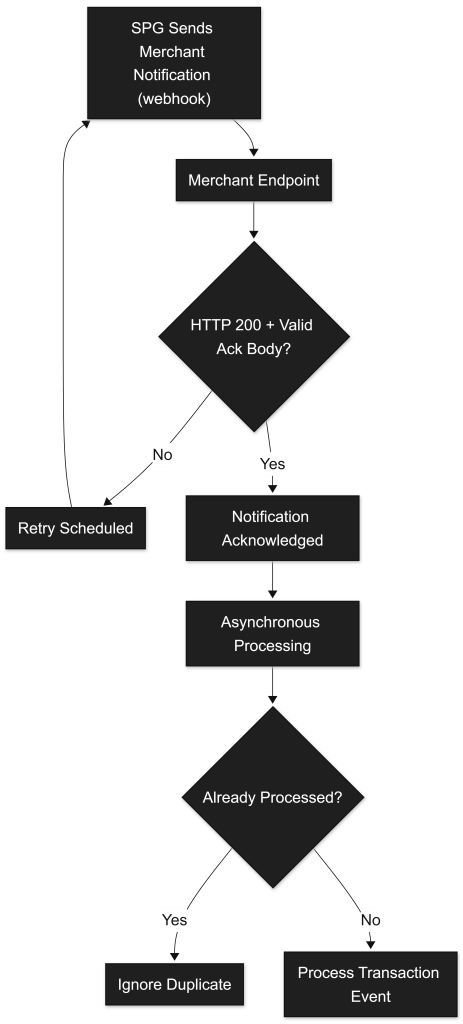
If a webhook delivery fails, SPG will attempt to resend the notification.
Typical Retry Scenarios
- Endpoint returns a response different from HTTP 200 OK, or a response body not matching the expected acknowledgement structure
- Endpoint is unavailable
- Network errors
- Request timeout
Expected Behavior
- Multiple delivery attempts for the same event
- Increasing delays between retries may occur depending on the SPG retry strategy and operational conditions
Duplicate Notifications
Due to the retry mechanism and delivery model, the same webhook may be received multiple times.
Failure to handle duplicates correctly may result in:
- Duplicate order updates
- Incorrect business state transitions
- Inconsistent system behavior
Idempotency Strategy
Webhook processing must be idempotent, meaning that processing the same event multiple times produces the same result.
Recommended Identifier
Use transactionID as the primary identifier for idempotent processing.
The notificationID may additionally be used to detect duplicate deliveries of the same webhook event, while transactionID should remain the authoritative transaction correlation identifier.
Implementation Approach
Basic Idempotency Model
- Receive webhook
- Extract
transactionID - Check if already processed
- If processed → ignore
- If not processed → process and store
Recommended Enhancements
- Persist processed transaction identifiers
- Store processing status (e.g., success, failed)
- Allow safe reprocessing in case of internal failures
Persist idempotency and processing state information in durable storage to ensure safe recovery across service restarts, failover events, or infrastructure disruptions.
Processing Order Considerations
Since webhooks may arrive out of order:
- Do not assume chronological sequence
- Always evaluate the current transaction state before applying updates
Detailed consistency and reconciliation strategies are described in E.1.8 – Webhooks vs Status Inquiry (Consistency Model) and E.2.6 – Consistency Model: Query vs Webhook.
Resilience and Recovery
To ensure robust processing:
- Combine webhook handling with periodic reconciliation
- Use the Status Inquiry APIs to recover from missed or delayed events
- Implement monitoring for failed or unprocessed notifications
Detailed polling strategies, reconciliation guidance, and operational recovery patterns are provided in E.2.5 – Polling Strategy and Best Practices and E.2.7 – Reconciliation Patterns.
Summary
SPG webhook delivery follows an asynchronous, at-least-once model, which requires careful handling on the merchant side.
A production-ready implementation must:
- Acknowledge notifications with HTTP 200 OK and the expected JSON response body:
statusCode: "000"statusMsg: "Success"notificationID:<original notificationID>
- Handle retries and duplicate deliveries
- Implement idempotent processing using
transactionID - Support out-of-order events
- Use the Status Inquiry APIs to confirm the final transaction state when no final webhook is available or when additional confirmation, recovery, or reconciliation is required
This ensures reliable and consistent transaction processing across all payment flows.