

Overview
The Inquiry Details API provides extended transaction data retrieval capabilities beyond the standard Status Inquiry APIs.
While Status Inquiry APIs return the latest transaction state available through the query API, the Inquiry Details API enables retrieval of additional transaction information and contextual metadata associated with the transaction lifecycle.
This capability is intended to support advanced operational, reconciliation, and investigation scenarios where additional transaction detail is required.
For the complete endpoint definition, authentication model, headers, and request semantics, refer to E.2.11 – Inquiry Details Endpoint Specification.
Role and Positioning
The Inquiry Details API complements the Status Inquiry APIs within the transaction status architecture.
Status Inquiry APIs remain the mechanism for retrieving the latest transaction state available through the query API.
The Inquiry Details API extends visibility by exposing additional data that may not be present in the standard status response.
These two mechanisms must be used together:
- Status Inquiry → transaction-state validation and final outcome confirmation when required
- Inquiry Details → extended transaction visibility and metadata retrieval
For the definition and behavior of the Status Inquiry APIs, refer to E.2.1 – Overview and Role in the Transaction Lifecycle.
When to Use the Inquiry Details API
The Inquiry Details API is intended for scenarios requiring deeper inspection of transaction data beyond standard status retrieval.
Typical use cases include:
- Detailed transaction investigation
- Inspection of payment-method-specific transaction attributes and lifecycle metadata
- Customer support operations requiring extended context
- Reconciliation processes requiring additional transaction attributes
- Audit and reporting workflows
- Analysis of transaction history and metadata
This API is not required for standard payment flow handling or basic transaction validation.
Functional Scope
The Inquiry Details API enables retrieval of additional transaction data beyond the core status model.
This may include:
- Extended transaction metadata
- Additional attributes associated with the transaction
- Contextual information related to processing and lifecycle events
- Data required for operational analysis and reconciliation
The exact data returned may vary depending on the payment method, transaction type, and processing context.
For the structure and interpretation of transaction response data, refer to E.2.3 – Response Payload Structure.
Relationship with Status Inquiry
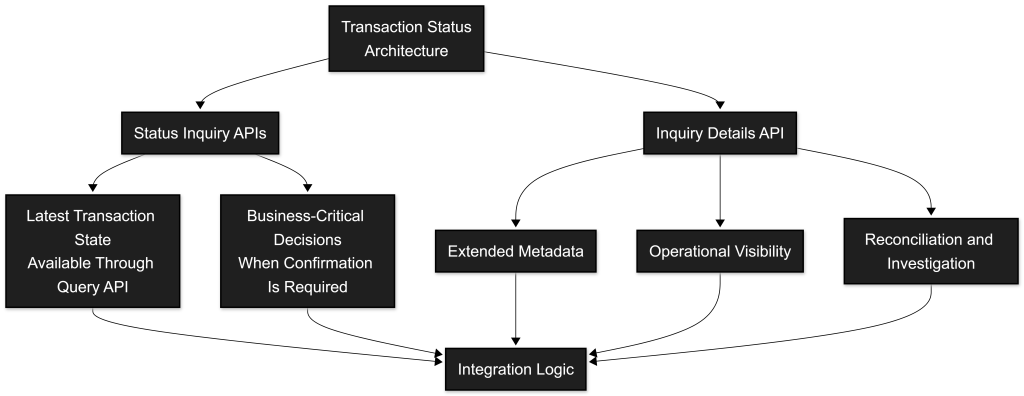
It is critical to distinguish the roles of each mechanism:
Status Inquiry APIs
- Returns the current transaction state
- Provides additional confirmation of final outcomes when required
- Should be used for business-critical decisions when no final webhook is available or when additional confirmation is required
Transaction-state semantics and interpretation rules are described in E.2.4 – Status Semantics and Interpretation.
Inquiry Details
- Provides extended transaction metadata and contextual information
- Does not replace Status Inquiry APIs
- Must not be used as the sole source for determining transaction finality
Business actions may be based on a final webhook paymentStatus or on Status Inquiry validation when no final webhook is available or when additional confirmation is required
Integration Considerations
The Inquiry Details API is typically used in backend systems and operational workflows.
It is not intended for real-time user-facing payment flows.
Integrators must:
- Continue using Status Inquiry APIs for state validation
- Use Inquiry Details only when extended data is required
- Ensure consistent correlation using
transactionID - Handle optional or variable data structures defensively
Operational Usage Patterns
Typical usage patterns include:
- Post-transaction analysis
- Reconciliation workflows
- Customer support investigations
- Audit and reporting processes
These operations are typically executed asynchronously or on-demand, outside of the core payment flow.
For reconciliation strategies using transaction state retrieval, refer to E.2.7 – Reconciliation Patterns.
Key Principles
- Status Inquiry APIs provide the latest transaction state available through the query API
- Inquiry Details provides extended visibility only
- Both mechanisms must be used in a complementary manner
- Business logic must never rely solely on extended data
- Integration logic must handle variability in returned data
Summary
The Inquiry Details API extends the transaction visibility capabilities of the SIBS Payment Gateway by providing access to additional transaction data beyond the standard status response.
It is intended for operational, reconciliation, and investigative use cases, and should be used in conjunction with the Status Inquiry APIs when additional confirmation or extended investigation is required to ensure correct and reliable transaction processing.