

Overview
This example illustrates a complete end-to-end flow for a two-step payment using Credit Card, where the transaction is split into:
- Authorization (AUTH) → funds are reserved
- Capture (CAPTURE) → funds are collected
It demonstrates how the merchant system:
- Creates a checkout configured for authorization
- Processes customer interaction through the hosted payment form
- Receives asynchronous updates via Webhooks
- Confirms the authorization result using a final webhook
paymentStatusor Status Inquiry when required - Executes a separate capture operation
- Validates the final captured state
This scenario represents a multi-phase transaction flow, requiring strict control of transaction state transitions and correct orchestration between authorization and capture steps.
The execution of this flow can be validated using the SIBS Postman Collections:
Goal
Authorize a payment using a credit card and capture the funds in a separate step, ensuring:
- Correct authorization handling
- Proper separation between authorization and capture
- Reliable state validation before capture
- Final reconciliation after capture using a final webhook
paymentStatusor Status Inquiry when required
Preconditions
Before executing this flow, the following must be in place:
- Valid SPG credentials:
terminalIdX-IBM-Client-IdBearertoken
- Configured Webhook endpoint
- Backend capable of storing:
transactionIDmerchantTransactionId
- Hosted form integration correctly implemented

(See collection root variables in SIBS PAYMENT GATEWAY POSTMAN Collection)
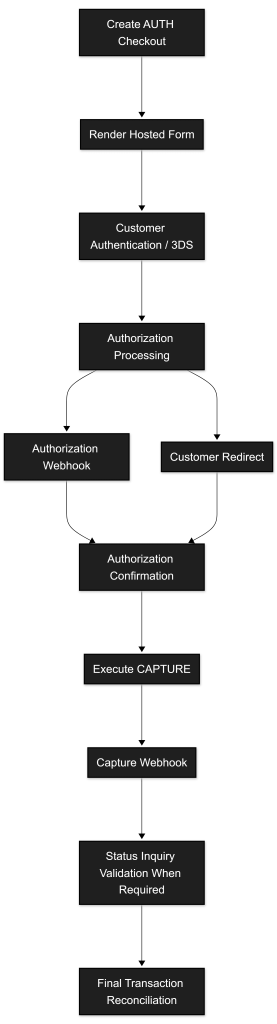
Figure – Two-Step AUTH → CAPTURE Operational Flow
Step 1 – Create Checkout
The merchant creates a checkout configured for authorization.
Endpoint
POST <ROOT_URL>/paymentsHeaders
Authorization: Bearer <AuthToken>
X-IBM-Client-Id: <clientId>
Content-Type: application/json
Accept: application/json
Example Request
{
    "merchant": {
        "terminalId": 11111,
        "channel": "web",
        "merchantTransactionId": "ORDER-AUTH-0001"
    },
    "transaction": {
        "transactionTimestamp": "2026-04-15T11:00:00.000Z",
        "description": "Authorization payment",
        "paymentType": "AUTH",
        "amount": {
            "value": 100.00,
            "currency": "EUR"
        },
        "paymentMethod": [
            "CARD"
        ]
    }
}

Key Outputs
transactionID→ primary identifierformContext→ required for hosted form
The transactionID returned in this step must be used as the primary identifier across all subsequent steps, including webhook processing and status validation.
Step 2 – Customer Interaction (Authorization)
The customer is redirected to the hosted payment form.
<script src="<ROOT_URL>/assets/js/widget.js?id={transactionID}"></script>

<form
  spg-context="{formContext}"
  spg-config='{"redirectUrl":"https://merchant.example.com/return"}'>
</form>
At this stage:
- The customer enters card details
- 3DS authentication may occur
- SPG processes the authorization request
No direct card data handling occurs on the merchant side. This integration model helps reduce PCI DSS scope by ensuring that sensitive cardholder data is collected and processed directly by the hosted SPG payment form.
Step 3 – Handle Customer Redirection
After authorization, the customer is redirected to the merchant.

Recommended behavior:
- Display a “processing authorization” state
- Trigger backend validation
The backend must use the transactionID obtained during checkout when Status Inquiry API requests are required.
Step 4 – Receive and Process Webhook Notifications (Authorization)
SPG sends a notification with the authorization result.
Example Payload
{
    "returnStatus": {
        "statusCode": "000",
        "statusMsg": "Success"
    },
    "paymentStatus": "Success",
    "paymentMethod": "CARD",
    "transactionID": "s2ExampleTxAUTH123",
    "paymentType": "AUTH",
    "notificationID": "notif-auth-001"
}
Processing Requirements
- Receive the notification
- Validate authenticity and integrity according to the configured webhook security model (e.g., decryption and header validation)
- Store and process the notification using
notificationIDas a unique identifier - Ensure idempotent processing
- Acknowledge correctly
Response to SPG
{
    "statusCode": "000",
    "statusMsg": "Success",
    "notificationID": "notif-auth-001"
}
The notificationID must match the value received in the webhook payload.
The reconciliation and validation mechanisms described in E. Notifications and Transaction Status should be followed where applicable.
Step 5 – Confirm Authorization (Status Inquiry APIs)
The merchant may confirm that authorization was successful using Status Inquiry when no final authorization webhook is available or when additional confirmation, recovery, or reconciliation is required.
Endpoint
GET <ROOT_URL>/payments/{transactionID}/statusHeaders
Authorization: Bearer <AuthToken>
X-IBM-Client-Id: <clientId>
Content-Type: application/json
Accept: application/jsonExample Response
{
    "returnStatus": {
        "statusCode": "000",
        "statusMsg": "Success"
    },
    "paymentStatus": "Success",
    "paymentType": "AUTH",
    "transactionID": "s2ExampleTxAUTH123",
    "amount": {
        "value": 100.00,
        "currency": "EUR"
    }
}
For scenarios requiring extended operational or financial information, integrations may additionally use the Inquiry Details endpoint documented in E.2 Status Inquiry / Get Status.
Step 6 – Capture the Payment
The merchant initiates the capture operation for the previously authorized transaction.
Endpoint
POST <ROOT_URL>/payments/{transactionID}/captureHeaders
Authorization: Bearer <AuthToken>
X-IBM-Client-Id: <clientId>
Content-Type: application/json
Accept: application/jsonExample Request
{
    "amount": {
        "value": 100.00,
        "currency": "EUR"
    }
}
Step 7 – Receive Webhook (Capture)
SPG sends a notification for the capture operation.
Example Payload
{
    "returnStatus": {
        "statusCode": "000",
        "statusMsg": "Success"
    },
    "paymentStatus": "Success",
    "paymentType": "CAPTURE",
    "transactionID": "s2ExampleTxAUTH123",
    "notificationID": "notif-capture-001"
}
Process this webhook using the same idempotent model.
Step 8 – Confirm Final State (Status Inquiry APIs)
The merchant may confirm that the capture operation has been successfully completed using Status Inquiry when no final capture webhook is available or when additional confirmation, recovery, or reconciliation is required.
Endpoint
GET <ROOT_URL>/payments/{transactionID}/statusHeaders
Authorization: Bearer <AuthToken>
X-IBM-Client-Id: <clientId>
Content-Type: application/json
Accept: application/json
Example Response
{
    "returnStatus": {
        "statusCode": "000",
        "statusMsg": "Success"
    },
    "paymentStatus": "Success",
    "paymentType": "CAPTURE",
    "transactionID": "s2ExampleTxAUTH123"
}
Final State Rule
Final transaction state may be determined from a final webhook paymentStatus or via Status Inquiry when required
This ensures consistency between:
- Customer interaction (frontend)
- Webhook notifications
- Backend reconciliation and processing
This ensures consistency between event execution, webhook notifications, and backend processing, particularly in scenarios involving delays, retries, or asynchronous flows.
Expected Final Outcome
- Authorization →
Success - Capture →
Success
Only after capture success should the merchant consider the payment completed.
Business fulfillment processes must not be triggered based solely on authorization success without confirmed capture completion.
Implementation Notes
- Authorization and capture are independent steps
- Capture must never be executed without confirmed authorization
- Webhooks must be processed idempotently
- Status Inquiry should be used when no final webhook is available or when additional confirmation is required
- Partial captures may be supported depending on configuration
- Time limits for capture may apply
Operational logs and monitoring systems should correlate transactionID, merchantTransactionId, and notificationID across authorization, capture, webhook processing, and reconciliation stages.
Use of Postman Collection
The Postman Collections should be used as the execution layer for this example.
Relevant Requests
- Checkout
SIBS PAYMENT GATEWAY → Card → Checkout Card- Status
SIBS PAYMENT GATEWAY → Card → getStatus- Capture
SIBS PAYMENT GATEWAY → Card → CaptureUse the previously referenced requests to execute each step, validate responses, and simulate different transaction outcomes in sandbox environments.
Recommended Usage
- Execute authorization flow
- Validate status before capture
- Execute capture
- Validate final status
Final Notes
This example demonstrates a complete two-step payment flow requiring strict control of transaction state.
For production-grade implementations:
- Use API responses for immediate control
- Use Webhooks for event awareness
- Use Status Inquiry APIs when no final webhook is available or when additional confirmation, recovery, or reconciliation is required
This ensures correct handling of multi-phase payments and avoids inconsistent or premature transaction finalization.