

Overview
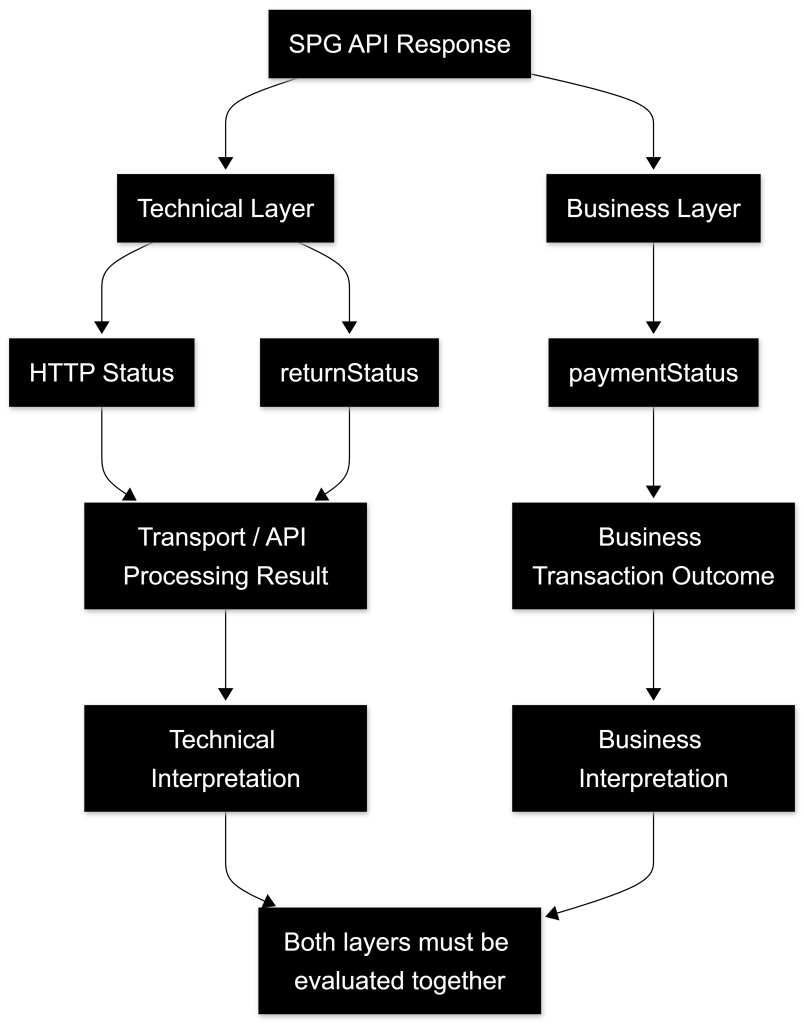
All SIBS Payment Gateway (SPG) interactions must be interpreted using a dual-layer model, separating technical processing outcomes from business transaction outcomes.
This distinction is fundamental to ensure that integrators:
- Avoid incorrect assumptions based on API responses
- Prevent premature business actions (e.g., order fulfillment)
- Maintain consistent transaction state management across all payment methods
The complete interpretation model and code definitions are described in C.5 – Status Codes and Error Codes Mapping.
Technical Outcome
The technical outcome reflects whether the request was successfully received, validated, and processed at the API level.
It is determined by:
- HTTP Status Code
- Indicates transport-level success or failure (e.g.,
200,400,401)
- Indicates transport-level success or failure (e.g.,
returnStatusobjectstatusCodestatusMsg
A typical successful technical response is:
{
    "returnStatus": {
        "statusCode": "000",
        "statusMsg": "Success"
    }
}
Interpretation
statusCode = "000"indicates that the request was successfully processed at technical level and does not guarantee a successful payment.- Any other code (e.g.,
E0xxx) indicates that the request did not complete successfully at technical level, although in some cases partial processing may still have occurred.
Key Characteristics
- Evaluated immediately upon API response
- Independent from payment method behavior
- Does not guarantee that a transaction was executed or completed
Business Outcome
The business outcome reflects the actual result of the payment transaction.
It is determined by:
paymentStatusfield
Typical values include:
Success→ Payment completed successfullyPending→ Awaiting user action or external processingDeclined→ Payment refusedError→ Processing failureTimeout→ Final transaction outcome not determined within expected timeframe
Interpretation
- Defines the financial and operational state of the transaction
- May evolve over time (e.g.,
Pending → Success) - Final
paymentStatusmust be used to drive business decisions and workflows
The returnStatus layer reflects the API processing result and does not independently determine the final business outcome of the transaction. Business interpretation must consider paymentStatus as the transaction outcome indicator when present in final webhook or Status Inquiry responses.
Combined Interpretation
Both layers must be evaluated together when paymentStatus is present.
Example 1 – Technical Success, Business Success
{
    "returnStatus": { "statusCode": "000" },
    "paymentStatus": "Success"
}
→ Payment completed successfully
Example 2 – Technical Success, Business Pending
{
    "returnStatus": { "statusCode": "000" },
    "paymentStatus": "Pending"
}
→ Payment not finalized; further action required
Example 3 – Technical Success, Business Declined
{
    "returnStatus": { "statusCode": "000" },
    "paymentStatus": "Declined"
}
→ Payment refused despite valid request
Example 4 – Technical Failure
{
    "returnStatus": { "statusCode": "E0101" }
}
→ Request rejected or not successfully completed at technical level
Key Rule

This rule must be strictly enforced in all integrations.
State Evolution and Timing
The technical outcome is instantaneous, while the business outcome may evolve over time.
Typical pattern:
- Initial response:
statusCode = "000"paymentStatus = "Pending"
- Final state (via webhook or Status Inquiry):
paymentStatus = "Success"orDeclined
This behavior is especially common in:
- MB WAY
- Multibanco Reference
- Card payments with 3DS
- Two-step flows (AUTH → CAPTURE)
Integrator Responsibilities
To correctly implement this model, integrators must:
- Evaluate both
returnStatusandpaymentStatuswhenpaymentStatusis present - Treat
Pendingas a valid and expected state - Base business actions on final
paymentStatus - Use the Status Inquiry (
GET <ROOT_URL>/payments/{transactionID}/status) to confirm final outcomes when required - Ensure internal systems support state transitions over time
For extended transaction diagnostics and additional contextual information, refer to E.2 – Status Inquiry / Get Status.
Common Anti-Patterns (To Avoid)
- Treating
statusCode = "000"as payment success - Ignoring
paymentStatusin initial responses - Assuming synchronous completion for all payment methods
- Triggering fulfillment actions while transaction is still
Pending - Failing to reconcile final state after asynchronous flows
Summary
The separation between technical outcome and business outcome is a core principle of SPG integrations.
- The technical layer confirms that the request was processed
- The business layer defines the actual transaction result
Correct implementation of this model ensures:
- Accurate transaction state management
- Proper handling of asynchronous flows
- Consistent and reliable business operations