

Overview
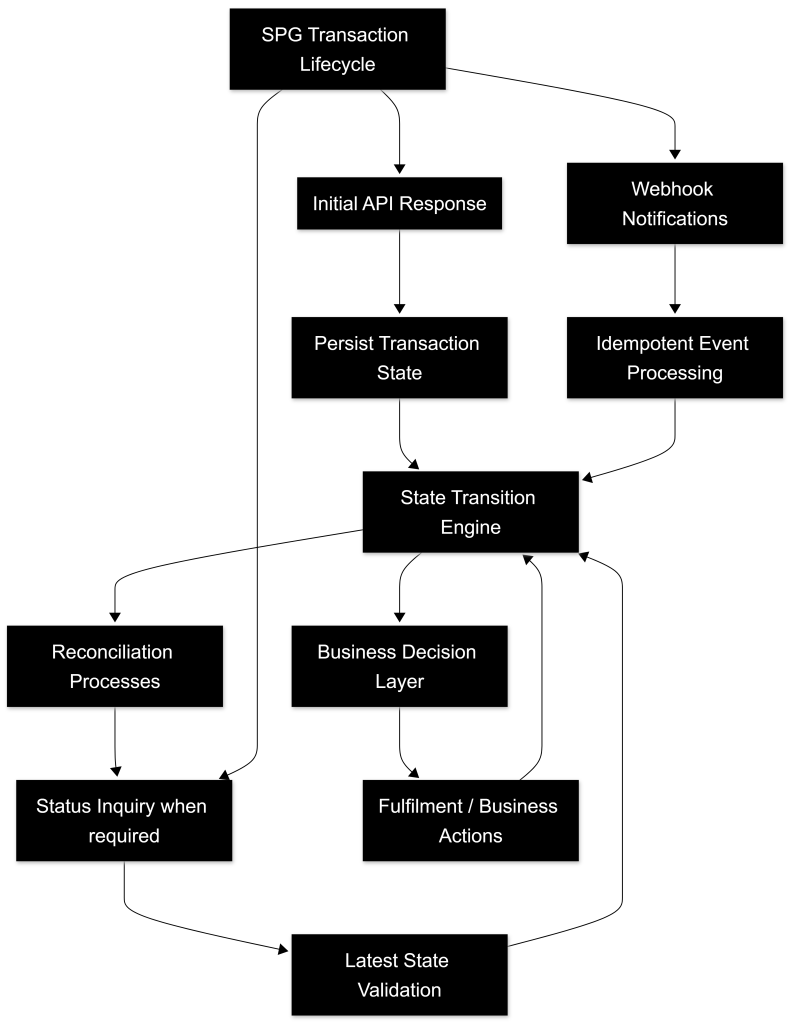
This section consolidates practical implementation guidelines for building robust SIBS Payment Gateway (SPG) integrations.
It focuses on how to implement the concepts defined in previous sections, ensuring:
- Correct handling of asynchronous flows
- Consistent transaction state management
- Resilient behavior under real-world conditions
The emphasis is on operational reliability, not on API usage details.
Error classification and handling strategies are defined in C.5 – Status Codes and Error Codes Mapping and its subchapters.
For the underlying asynchronous lifecycle and consistency model, refer to F.3.4 – Asynchronous and Consistency Scenarios.
Adopt a State-Driven Design
Integrations must be designed around persistent transaction state transitions rather than isolated request/response interactions.
Guidelines
- Model transactions using states such as:
Pending,Success,Declined,Timeout
- Persist state transitions explicitly
- Ensure state transitions are:
- Deterministic
- Forward-only
Rationale
SPG is inherently asynchronous and event-driven, making state-based modeling essential for correctness.
Separate Technical and Business Logic
Maintain a strict separation between:
- Technical processing
- Business actions
Guidelines
- Use
returnStatusfor:- API validation
- Technical success/failure
- Use
paymentStatusfor:- Business decisions
- Transaction outcome
- Never trigger business actions based solely on:
- HTTP status
returnStatus.statusCode
Treat Pending as a First-Class State
Pending is a normal and expected state, not an exception.
Guidelines
- Always support
Pendingin:- Persistence model
- Business workflows
- Design processes to:
- Wait for final confirmation
- Handle long-lived pending states
Rationale
Many payment methods (e.g., MB WAY, Multibanco Reference) rely on external or delayed confirmation.
Use Webhooks and Status Inquiry Complementarily
Do not rely exclusively on a single mechanism.
Guidelines
- Use webhooks for:
- Real-time updates
- Event-driven processing
- Use the Status Inquiry (
GET <ROOT_URL>/payments/{transactionID}/status- Final state confirmation
- Recovery from missed or delayed events

For webhook delivery semantics, retry behavior, payload validation, and security recommendations, refer to E.1 – Webhooks (Notifications).
Implement Idempotent Processing
All transaction processing must be idempotent by design.
Guidelines
- Ensure that:
- The same event can be processed multiple times safely
- Use identifiers such as:
transactionIDmerchantTransactionId
- Protect against:
- Duplicate webhook deliveries
- Retried operations
Rationale
Distributed systems cannot guarantee single delivery.
Enforce Safe State Transitions
Prevent invalid or inconsistent state changes.
Guidelines
- Do not allow transitions such as:
Success → PendingDeclined → Pending
- Define and protect terminal business states such as:
SuccessDeclined
- Reject updates that attempt to overwrite final states
Design for Eventual Consistency
Assume that systems are temporarily inconsistent.
Guidelines
- Do not assume:
- Immediate synchronization between systems
- Expect:
- Delayed updates
- Out-of-order events
- Validate final state using Status Inquiry when no final webhook is available or when confirmation, recovery, or reconciliation is required (
GET <ROOT_URL>/payments/{transactionID}/status
Implement Reconciliation Mechanisms
Reconciliation is mandatory for production systems.
Guidelines
- Periodically query transactions in:
PendingTimeout
- Detect and resolve:
- Missing updates
- Inconsistent states
- Maintain audit logs for:
- All state transitions
Handle Timeouts and Uncertain States Properly
Timeout represents an uncertain state and must not be interpreted as final failure without validation.
Guidelines
- Treat
Timeoutas:- Uncertain state
- Always:
- Confirm via the Status Inquiry (
GET <ROOT_URL>/payments/{transactionID}/status - Delay business decisions until resolved
- Confirm via the Status Inquiry (
Ensure Observability and Traceability
Visibility is essential for debugging and operations.
Guidelines
- Log:
- Requests and responses
- Webhook payloads
- State transitions
- Correlate using:
transactionIDmerchantTransactionId
- Ensure logs support:
- Debugging
- Audit and reconciliation
Control Retry Strategies Carefully
Retries must be intentional and controlled.
Guidelines
- Retry only when errors are classified as temporary (
statusCode = Txxxx) or retryable according to the applicable SPG status and error semantics. - Avoid:
- Blind retries
- Duplicate transaction creation
- Use:
- Backoff strategies
- Status Inquiry checks (
GET <ROOT_URL>/payments/{transactionID}/status
Summary
Robust SPG integrations require:
- State-driven design
- Strict separation of concerns
- Idempotent and resilient processing
- Explicit handling of asynchronous behavior
By applying these practices, integrators ensure:
- Reliable transaction processing
- Accurate financial outcomes
- Stability under real-world operational conditions