

Production-ready integrations must ensure that all transaction data remains accurate, consistent, and reliable across the full transaction lifecycle and across all participating systems.
In SIBS Payment Gateway (SPG) integrations, data integrity is critical to guarantee that transaction outcomes, amounts, identifiers, and states are correctly represented and preserved, even under asynchronous processing, retries, and failure conditions.
A system that does not enforce strong data integrity controls will produce inconsistencies, reconciliation issues, and potential financial discrepancies.
Integrity of Transaction Data
All transaction data exchanged with SPG must be:
- Correctly structured and validated
- Consistently represented across systems
- Preserved without unintended or unauthorized modification
This includes:
- Transaction identifiers (
transactionID,merchant.merchantTransactionId) - Monetary values (
amount.value,amount.currency) - Transaction metadata (timestamps, descriptions)
- Transaction state (
paymentStatus,returnStatus)
Incorrect or inconsistent data may result in:
- Rejected API requests
- Misinterpretation of transaction outcomes
- Reconciliation mismatches
See C.2 – Field Semantics and Validation Rules.
Consistency Across System Boundaries
Transaction data must remain consistent between:
- SPG platform
- Merchant system
- Downstream business systems
This requires that:
- The same transaction identifiers are used consistently across all interactions
- Data values (e.g., amount, currency) remain unchanged throughout the lifecycle
- Internal representations reflect the validated transaction state returned by SPG
Any divergence between systems must be:
- Detectable through observability mechanisms
- Resolvable through reconciliation processes

Transaction-State Consistency
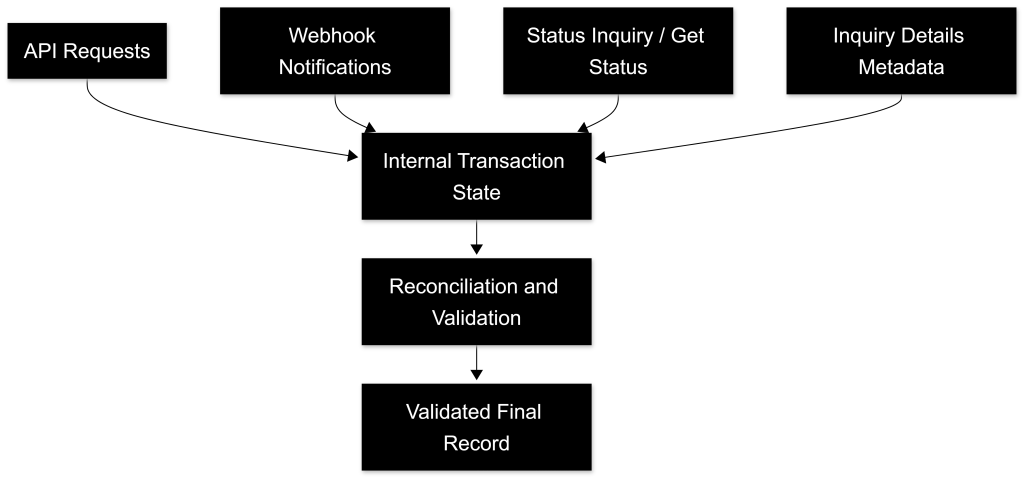
Transaction state and data must be derived from validated SPG transaction-state data and kept consistent throughout the lifecycle.
In SPG integrations:
- Status Inquiry provides the latest transaction state available through the query API when confirmation or reconciliation is required
- Webhooks provide event-driven updates and must be decrypted, validated, correlated, and checked against the expected transaction lifecycle before updating state
- Inquiry Details responses may provide extended transaction context and historical information useful for reconciliation, validation, and investigation of complex transaction flows
A production-ready system must:
- Align internal data with validated transaction-state data
- Avoid relying on intermediate or inferred data
- Ensure that final transaction records reflect confirmed outcomes
See F.6.3 – Asynchronous Flow Readiness and F.6.4 – Webhook Reliability and Processing Guarantees.
Protection Against Data Corruption and Drift
Data must remain stable throughout the transaction lifecycle.
This requires:
- Preventing unintended modification of transaction records
- Ensuring immutability of critical fields once a transaction is initiated
- Avoiding duplication or divergence of transaction data across components
Controls must ensure that:
- Reprocessing or retries do not alter original transaction data
- Duplicate events do not create conflicting records
- Replay and retry scenarios must also prevent duplicate downstream business processing and inconsistent business-side data propagation
- State transitions do not introduce inconsistent values
See F.6.2 – Transaction Idempotency and Duplicate Protection.
Handling of Concurrent and Asynchronous Updates
Asynchronous processing introduces scenarios where multiple updates may affect the same transaction.
A production-ready system must:
- Ensure that updates are applied in a controlled and consistent manner
- Prevent race conditions and conflicting updates
- Validate state transitions before applying changes
This includes:
- Handling duplicate or out-of-order webhook notifications
- Coordinating updates from multiple processing paths, including webhook processing, reconciliation flows, retry operations, and recovery procedures
- Ensuring that final states are not overridden or regressed
See F.6.4 – Webhook Reliability and Processing Guarantees.
Reconciliation and Data Validation
Reconciliation processes must ensure that transaction data is consistent across all systems.
This requires:
- Comparing internal transaction records with validated SPG transaction-state data
- Identifying discrepancies in state, amount, or identifiers
- Resolving inconsistencies through controlled correction processes
- Recovery and reconciliation mechanisms must continue until transaction data consistency is restored
Reconciliation must be:
- Periodic and event-driven
- Capable of handling delayed or missing updates
- Supported by observability and traceability mechanisms
Discrepancies caused by temporary conditions (statusCode = Txxxx) must be resolved through retry or reconciliation, while validation or business errors (statusCode = Exxxx) must be corrected at source.
See F.6.6 – Operational Resilience and Failure Strategy for recovery and resilience guidance under failure conditions.
See also F.6.7 – Production Observability Prerequisites for observability, traceability, and reconciliation monitoring requirements.
Validation of Data Throughout the Lifecycle
Data validation must be applied at all stages:
- Input validation before API requests
- Response validation after API calls
- Event validation during webhook processing
- Final validation during reconciliation
This ensures that:
- Invalid data is detected early
- Inconsistencies are prevented from propagating
- Transaction integrity is maintained end-to-end
Operational Controls for Data Integrity
Production systems must enforce controls that guarantee data reliability.
This includes:
- Strict validation rules for all transaction fields
- Controlled update mechanisms for transaction state
- Auditability of all data changes
- Observability and traceability mechanisms capable of identifying integrity violations, reconciliation discrepancies, and inconsistent transaction evolution
These controls must ensure that:
- Data remains consistent under retries, failures, and asynchronous updates
- All changes are traceable and verifiable
- Transaction records reflect the validated transaction state
Final Consideration
Data integrity is a foundational requirement for financial correctness.
A production-ready integration ensures that:
- Transaction data remains accurate and consistent across all systems
- Validated transaction state is consistently respected
- Asynchronous and concurrent updates do not introduce inconsistencies
- Reconciliation processes can reliably confirm correctness
Without strong data integrity and consistency controls, even technically correct integrations may produce incorrect financial outcomes and operational risk.